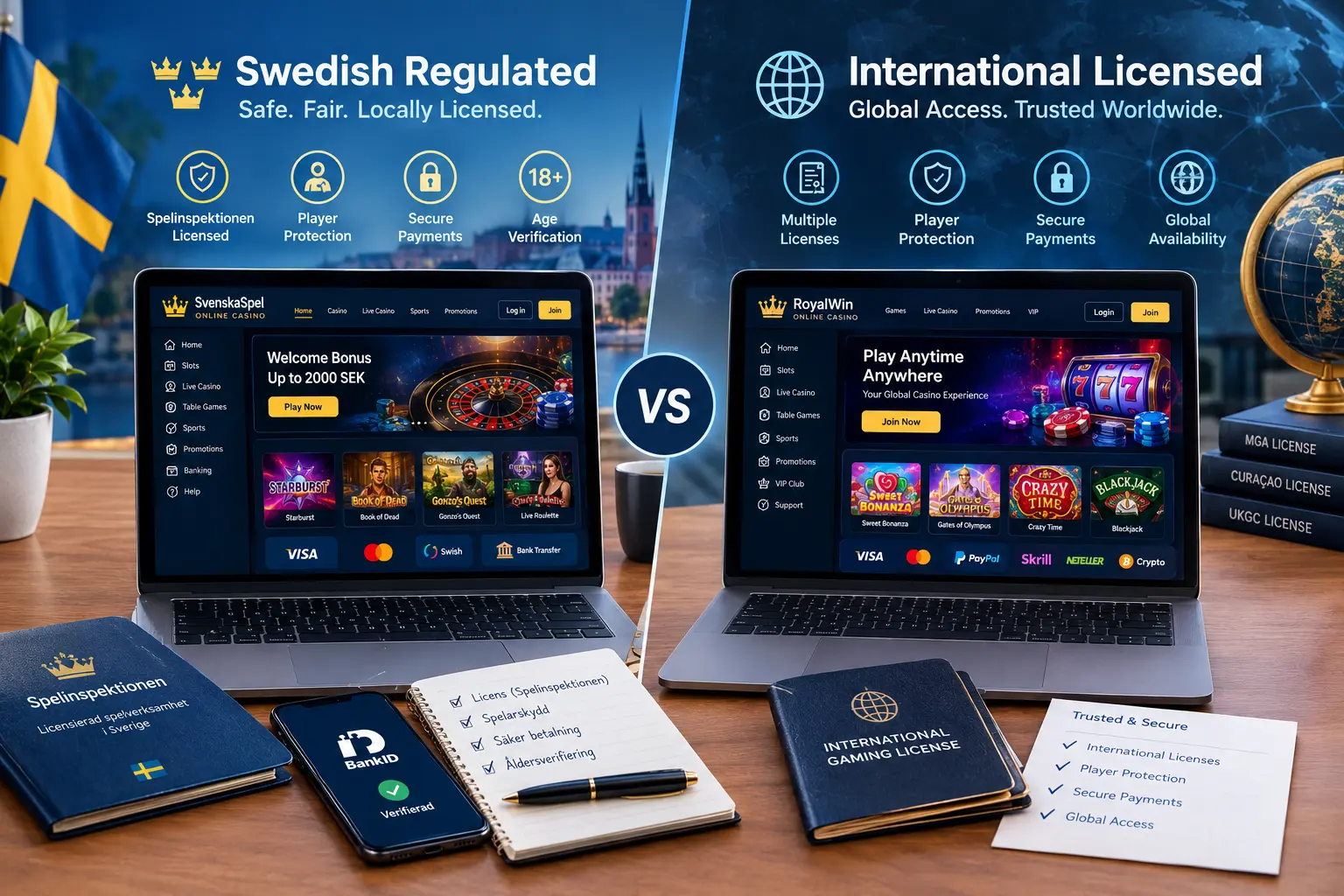
The difference between a Swedish licence vs foreign casino mainly concerns the regulatory framework under which the gambling operator provides its services. A Swedish-licensed operator is regulated under Sweden’s gambling framework, while a foreign casino may operate under a licence issued by another jurisdiction.
For players comparing these options, the important questions involve more than where a website is based. Licensing, self-exclusion, taxation, verification, payments and consumer-protection arrangements can all differ.
What Does a Swedish Gambling Licence Mean?
A Swedish gambling licence means that an operator has been authorised to provide gambling services under the Swedish regulatory system.
The relevant authority is the Swedish Gambling Authority, known as Spelinspektionen. A licensed operator must follow the requirements that apply to the gambling activities covered by its licence.
For players, this can affect several parts of the gambling experience, including registration, responsible-gambling measures, marketing and account management.
A Swedish licence therefore identifies the regulatory framework behind the gambling service. It does not simply describe the physical location of the company’s headquarters.
What Is a Foreign Online Casino?
A foreign online casino is generally an operator that provides gambling services under a regulatory framework outside Sweden.
The operator may hold a gambling licence from another jurisdiction. The exact rules depend on the licence, the operator and the countries in which the service is offered.
This makes it important to identify the actual licensing authority rather than treating every foreign casino as belonging to one uniform category.
Foreign operators can differ considerably in their registration systems, payment methods, verification requirements and responsible-gambling procedures.
Swedish Licence vs Foreign Casino: Main Differences
The most useful comparison is to examine the specific features that can affect an account.
| Area | Swedish-licensed casino | Foreign casino |
|---|---|---|
| Regulatory framework | Swedish gambling rules | Rules of another jurisdiction |
| Licensing authority | Swedish Gambling Authority | Depends on the operator |
| Spelpaus | Applies to registered gambling covered by the Swedish system | Not automatically part of the Swedish system |
| Verification | Subject to applicable Swedish requirements | Depends on the operator and licence |
| Tax treatment | Depends on applicable Swedish rules | Depends on the operator, jurisdiction and player’s circumstances |
| Payment options | Depends on operator | Can vary by market and provider |
| Consumer protections | Determined by Swedish gambling framework | Determined by applicable foreign framework |
This table shows why the term “foreign casino” is not enough to understand how a particular operator works. The individual licence and terms still need to be examined.
How Does Spelpaus Differ?
Spelpaus is an important distinction for Swedish players.
The national self-exclusion system is connected to gambling companies licensed in Sweden for gambling that requires registration. A player using Spelpaus can exclude themselves from registered gambling covered by the Swedish system.
This means that Spelpaus should not be treated as a universal blocking system for every gambling website on the internet.
When researching foreign casino options, players should therefore understand which regulatory system the operator belongs to and whether Swedish self-exclusion mechanisms apply to that service.
The distinction matters because self-exclusion arrangements can depend on the licence and regulatory jurisdiction.
Does Licensing Affect Player Protection?
Yes, the applicable regulatory framework can determine which player-protection requirements an operator must follow.
These requirements can cover areas such as responsible gambling, marketing, registration and account management. However, the precise protections depend on the relevant jurisdiction and licence.
Rather than assuming that all Swedish or foreign operators work in exactly the same way, players should examine the specific operator’s rules.
Useful information can usually be found in the terms and conditions, responsible-gambling section and licensing information.
How Can Tax Rules Differ?
Tax treatment is another area where players should avoid broad assumptions.
The taxation of gambling winnings can depend on factors such as the operator, its jurisdiction and the player’s individual circumstances. A casino’s location alone does not provide enough information to determine the tax treatment of a particular person’s winnings.
Players considering an operator outside Sweden should therefore distinguish between the casino’s promotional claims and the tax rules that may actually apply to them.
For questions involving personal tax obligations, official tax guidance is more appropriate than relying solely on a casino’s marketing material.
Are Payment Methods Different?
Payment options can vary between Swedish-licensed and foreign operators.
A casino may offer bank transfers, cards, e-wallets or other digital payment methods. Availability can depend on the operator, the player’s country, the payment provider and applicable restrictions.
Withdrawal procedures can also differ from deposit procedures. Before depositing, it is useful to check both sides of the transaction.
Look for:
- Available deposit methods
- Available withdrawal methods
- Transaction limits
- Verification requirements
- Processing conditions
- Possible fees
- Currency restrictions
Payment convenience is therefore only one part of the wider comparison.
Does KYC Work Differently?
KYC means Know Your Customer and refers to identity-verification procedures.
A Swedish-licensed operator may have specific verification obligations under Swedish gambling rules. A foreign operator may follow the requirements of its own licensing jurisdiction.
In either case, players should expect that an operator can require information or documents to verify an account. The exact procedure can vary.
Before registering, check what identity documents may be requested and whether verification can affect withdrawals.
What Should You Check When Comparing Operators?
A practical comparison can begin with six questions:
1. Who operates the website?
Find the legal company responsible for the gambling service.
2. Which authority issued the licence?
Identify the licensing jurisdiction and verify the operator’s stated licence information where possible.
3. Which self-exclusion tools apply?
Understand whether the operator participates in a national or jurisdiction-specific self-exclusion system.
4. How are withdrawals handled?
Review payment methods, verification requirements and withdrawal conditions before depositing.
5. What rules apply to taxation?
Do not assume that the same tax treatment applies to every gambling operator or every player.
6. What consumer protections are available?
Read the responsible-gambling information and understand the mechanisms available for managing an account.
Common Questions About Swedish and Foreign Casinos
Is a foreign casino the same as an unlicensed casino?
No. “Foreign” describes the regulatory location or jurisdiction relative to Sweden. A foreign operator may still hold a gambling licence in another jurisdiction.
Does a Swedish licence automatically mean every gambling product is covered?
Not necessarily. The scope of an operator’s licence matters. Players should check what gambling activities the licence actually covers.
Can Swedish players use every foreign casino?
No. Operators can restrict customers from particular countries, and applicable laws and terms can differ.
Is Spelpaus available at every foreign casino?
Spelpaus is connected to the Swedish system for registered gambling covered by Swedish-licensed operators. It should not be assumed to apply to every foreign gambling website.
Comparing the Regulatory Frameworks
The most useful way to compare a Swedish licence with a foreign casino is to look at the specific rules behind each operator rather than relying on labels alone.
Check the licence, operator identity, self-exclusion arrangements, verification process, payment conditions and relevant tax information. These details explain how the service operates and which regulatory framework governs it.
A careful comparison can help readers understand the practical differences between Swedish-licensed gambling and gambling services operating under another jurisdiction.