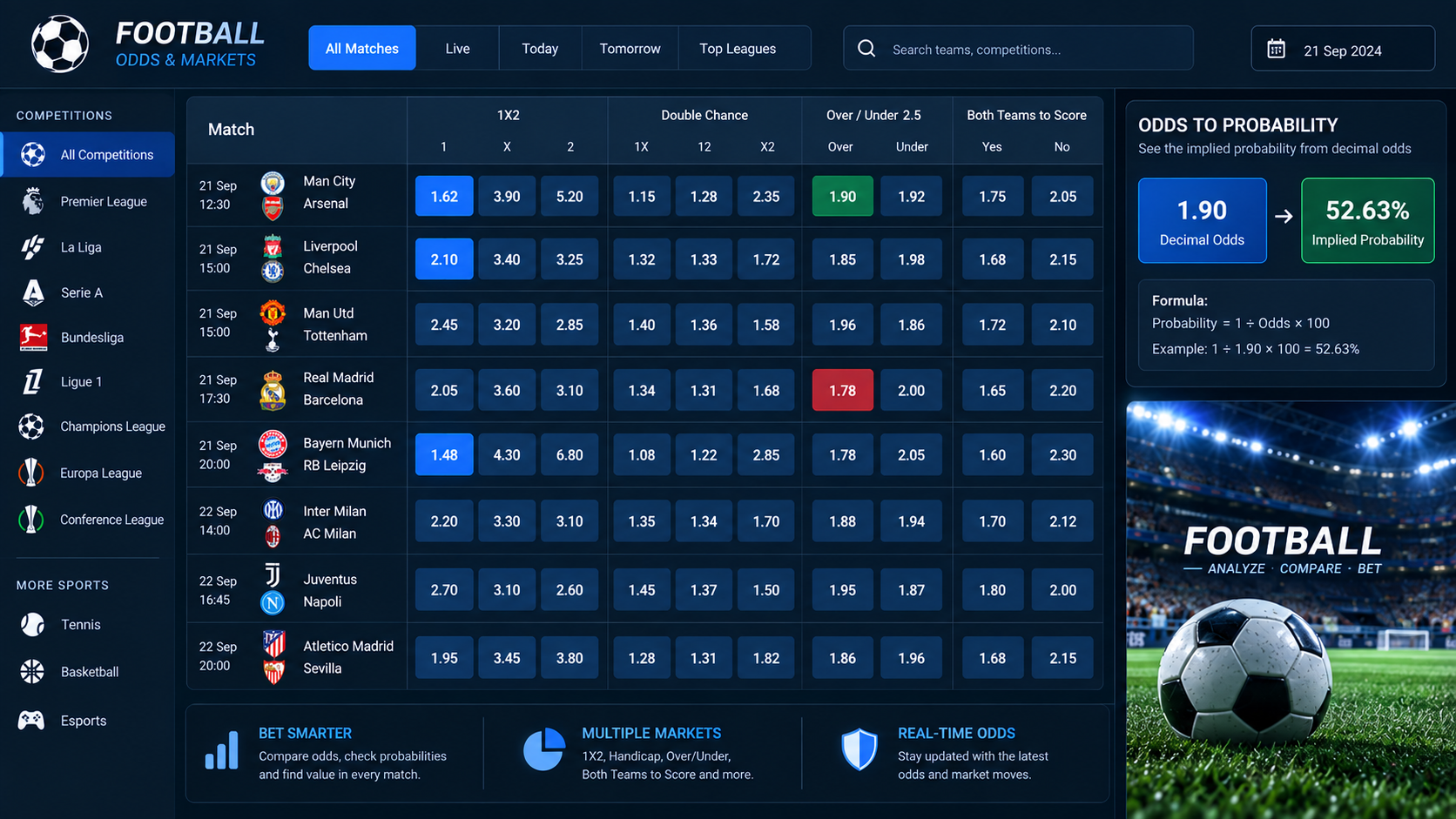
Learning how to read football odds starts with separating three basic pieces of information: the football fixture, the market being offered, and the odds attached to each possible selection. Odds are easier to understand when readers first identify exactly what outcome the market is measuring rather than viewing the numbers in isolation.
A single football match can contain many different markets. Therefore, the same team may appear beside several different odds because each number relates to a specific selection and set of conditions.
What Do Football Odds Represent?
Football odds are numerical prices attached to defined outcomes within a market. They can also be converted into an implied probability, although that figure should not be confused with certainty about what will happen.
For example, decimal odds might appear as:
Home win — 2.00
Draw — 3.40
Away win — 3.70
Each number belongs to a different selection in the same 1X2 market.
The important relationship is:
Fixture → Market → Selection → Odds
Understanding that sequence makes complex sportsbook screens easier to interpret.
How to Read Football Odds in Decimal Format
Decimal odds are commonly displayed as numbers such as 1.80, 2.00, or 3.50.
The number represents the total return per unit staked if the selection is settled as a winner, including the original stake. For educational purposes, the basic calculation is:
Potential total return = Stake × Decimal odds
For example, a hypothetical 10-unit stake at decimal odds of 2.00 would correspond to a total return of 20 units if that selection won under the applicable market rules.
This calculation explains the format. It does not indicate that the outcome is guaranteed or likely to occur.
What Is Implied Probability?
Decimal odds can be converted into an approximate implied probability using a simple formula:
Implied probability = (1 ÷ Decimal odds) × 100
For example, decimal odds of 2.00 convert to:
1 ÷ 2.00 × 100 = 50%
Odds of 4.00 convert to 25%.
However, these percentages should be interpreted carefully. Sportsbook pricing can include a built-in margin, so the implied percentages across all selections in a market may add up to more than 100%.
More importantly, implied probability is derived from the displayed price. It is not a guarantee or independent prediction of the match result.
Read the Market Name Before the Odds
One of the most useful habits when examining football information is to identify the market before focusing on its numbers.
Consider the following:
Home win — 1.90
Over 2.5 goals — 1.90
Although both selections have identical decimal odds, they describe completely different outcomes.
The first relates to which team wins. The second concerns the total number of goals.
A reader who looks only at the price misses the most important information: what must actually happen for the selection to satisfy its market conditions.
Common Football Markets and Their Information
Football interfaces can organize numerous markets around one fixture. Several common categories illustrate why labels matter.
1X2
The 1X2 market normally represents three match-result outcomes:
1 — home win
X — draw
2 — away win
The odds beside each symbol relate specifically to that outcome.
Over/Under
An over/under market compares a defined statistic, commonly total goals, with a numerical line such as 2.5.
The reader must identify both the direction and the line, such as Over 2.5 or Under 2.5.
Handicap
A handicap market applies a specified numerical adjustment to a team for market-evaluation purposes.
Here, the line is essential. A team at -0.5 represents different conditions from the same team at -1.5.
Therefore, odds should never be separated from their market labels and numerical lines.
Why Sportsbook Layout Matters
A well-structured interface usually groups related selections under identifiable market headings. This helps readers distinguish match-result odds from totals, handicaps, and other categories.
When examining a football sportsbook platform, the useful approach is to identify the fixture first, then locate the market heading, selection label, relevant line, and associated odds. Reading information in this order reduces the risk of confusing similarly displayed numbers from different markets.
The surrounding market context is just as important as the odds themselves.
Prematch and Live Odds Are Different Contexts
Football market information may be presented before a match begins or while an event is taking place.
Prematch odds are displayed before the relevant event starts.
Live odds relate to markets available during an ongoing match.
Live market information can change as the event develops. Therefore, readers should pay attention to whether they are viewing prematch or live information instead of assuming that every displayed price belongs to the same stage of the fixture.
Market availability and conditions can also differ between these contexts.
Why Similar Odds Do Not Mean Similar Outcomes
Two selections displaying the same decimal number are not necessarily comparable.
For example:
Team A to win — 2.10
Over 3.5 goals — 2.10
The numbers match, but the underlying conditions do not.
The first selection concerns the match result. The second concerns a goal-total threshold.
This is why football odds should always be interpreted together with their associated entities:
team, market, selection, line, match period, and price.
Removing any of these details can change the meaning of the information.
How Do Odds Work in a Parlay?
A parlay combines multiple selections into one structure.
Instead of evaluating one selection independently, the combined structure depends on the settlement of its included selections according to the applicable rules.
The individual odds contribute to the combined price, but each selection still retains its original market meaning.
For example, combining a 1X2 selection with an over/under selection does not turn them into the same type of market. One still concerns the match result, while the other concerns a defined total.
Readers should therefore understand every component separately before interpreting the combined information.
Do Lower Football Odds Mean an Outcome Is Certain?
No. Odds do not make an outcome certain.
Lower decimal odds correspond to a higher implied probability than higher decimal odds when converted mathematically. However, football remains uncertain, and the actual result can differ from what the pricing might appear to suggest.
For example, odds of 1.50 produce a higher implied probability than odds of 3.00, but neither figure guarantees an outcome.
This distinction is important because price, probability, and certainty are not the same concept.
A Simple Checklist for Reading Football Market Information
A football odds panel becomes easier to understand when read in a consistent order.
First, identify the two teams and the fixture.
Next, determine whether the information is prematch or live.
Then locate the specific market, such as 1X2, handicap, or over/under.
Read the exact selection and any numerical line attached to it.
Finally, examine the odds.
In simplified form:
Match → Timing → Market → Selection → Line → Odds
This method provides context before the numerical price is interpreted.
Understanding Odds Without Confusing Them With Predictions
Knowing how to read football odds is primarily about understanding how information is organized. The odds belong to a defined selection, and that selection belongs to a particular market within a football fixture.
Decimal odds can be converted into implied probability, but neither odds nor implied percentages guarantee what will happen on the field. Market labels, numerical lines, match periods, and selection conditions remain essential parts of the interpretation.
By reading the fixture and market first and the odds afterward, readers can understand football sportsbook information more accurately without treating isolated numbers as predictions.