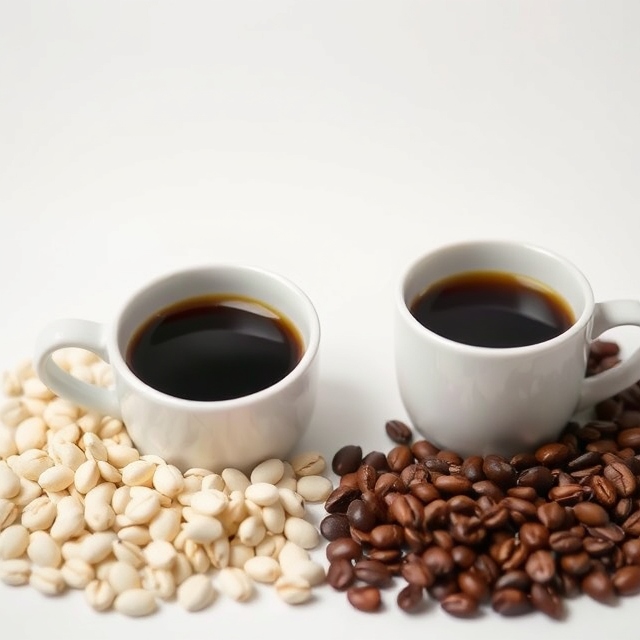
White coffee vs dark roast is a useful comparison for anyone trying to understand how roasting changes the character of coffee. Although both start as green coffee beans, the amount of heat and roast development they receive can produce very different colors, aromas, textures, and flavors.
The difference is not simply that one coffee is lighter and the other is darker. Roast development influences how the original characteristics of the beans interact with flavors created during roasting. That is why a very lightly roasted coffee can taste noticeably different from a traditional dark roast.
What Is White Coffee?
White coffee generally refers to coffee roasted to an unusually light level. The beans retain a pale appearance compared with conventional roasted coffee, and they can be significantly denser and harder than beans that have undergone more extensive roasting.
The term can be confusing because “white coffee” is also used in some regions to describe coffee served with milk or a particular regional preparation. In the roasting context, however, white coffee refers to an extremely light roast style.
Because roast development is limited, the resulting cup may emphasize characteristics that are less noticeable in darker coffees. Depending on the bean and brewing method, flavors can include nutty, grain-like, mild, earthy, or tea-like notes.
What Happens During a Dark Roast?
Dark roasting exposes coffee beans to substantially more heat and roast development. As the beans continue roasting, they become darker, more brittle, and more developed in flavor.
The extended roasting process encourages chemical reactions that create familiar roasted aromas and flavors. Dark-roasted coffee often has a fuller, heavier sensory profile, with notes that may remind drinkers of cocoa, toast, smoke, caramelized sugars, or bittersweet chocolate.
The original characteristics of the green coffee can still matter, but extensive roasting can make roast-derived flavors more prominent.
White Coffee vs Dark Roast: The Main Differences
The easiest way to understand the contrast is to look at several characteristics together.
Color and appearance
White coffee beans are pale because they have undergone much less roast development. Dark-roasted beans are visibly brown to very dark brown and may develop an oily surface depending on the roast.
Color is useful for identifying roast level, but it is not a complete measure of coffee quality. Different beans and roasting methods can produce different appearances.
Flavor
White coffee can have a lighter, more unusual flavor profile. Nutty, mild, cereal-like, or delicate characteristics may stand out more clearly.
Dark roast coffee generally produces stronger roasted flavors. Smoky, toasted, bitter, cocoa-like, and bittersweet notes are common descriptions, although the exact flavor depends on the coffee and roast.
Bitterness
Roast level can influence perceived bitterness. Darker roasting often produces a more pronounced bitter or roasted character, while an unusually light roast may taste brighter, milder, or more delicate.
However, bitterness also depends on brewing. Over-extraction, water temperature, grind size, and brew time can all affect the final cup.
Bean density and grinding
One of the practical differences is physical rather than sensory. Very lightly roasted beans can remain unusually dense and hard because less roasting has taken place.
That can make them more demanding to grind than ordinary roasted coffee. For some home brewers, using pre-ground coffee can therefore be more practical than attempting to process exceptionally hard beans with a basic grinder.
Brewing behavior
White coffee and dark roast coffee can require different approaches to brewing. The grinder setting, water temperature, contact time, and extraction method all influence the result.
Espresso, drip brewing, French press, and pour-over can each produce different results because they expose the grounds to water in different ways. A brewing recipe that works well for a conventional dark roast should not automatically be assumed to work identically for an unusually light roast.
What About Caffeine?
Caffeine is often mentioned when comparing light and dark roasts, but roast color alone does not determine exactly how much caffeine ends up in a cup.
The amount of coffee used, bean type, serving size, grind, brewing method, and extraction all matter. Therefore, it is too simplistic to assume that every light roast or every dark roast automatically contains more caffeine.
For people specifically interested in caffeine, the preparation and serving size should be considered alongside the roast level.
Choosing Between the Two
Someone who enjoys bold, deeply roasted flavors may prefer the sensory character commonly associated with dark roast coffee. It can work well for drinkers who enjoy strong roasted, toasted, or bittersweet notes.
Someone looking for something less conventional may be interested in white coffee. Its unusually light roast can provide a different experience, particularly for people curious about nutty or milder flavor characteristics.
For readers who want to explore the characteristics of this unusual roast style in more detail, white coffee compared with dark roast offers another reference point for understanding how an extremely light roast differs from traditional coffee.
Is White Coffee the Same as a Light Roast?
Not necessarily. “Light roast” covers a broad range of roast levels, while white coffee is commonly used for an exceptionally light roast that is noticeably paler and less developed than conventional light-roasted coffee.
That distinction matters because two coffees can both be described as light while behaving quite differently during grinding, brewing, and tasting.
The Bottom Line
White coffee vs dark roast is ultimately a comparison between very different stages of roast development. White coffee retains a pale appearance and can have a lighter, nutty, or unusual flavor profile, while dark roast develops deeper roasted characteristics and a darker appearance.
Neither description tells the entire story by itself. Bean origin, processing, roast technique, grind, brewing method, and personal taste all influence the final cup. Understanding these differences makes it easier to choose a coffee based on the experience you actually want rather than relying only on the color of the beans.