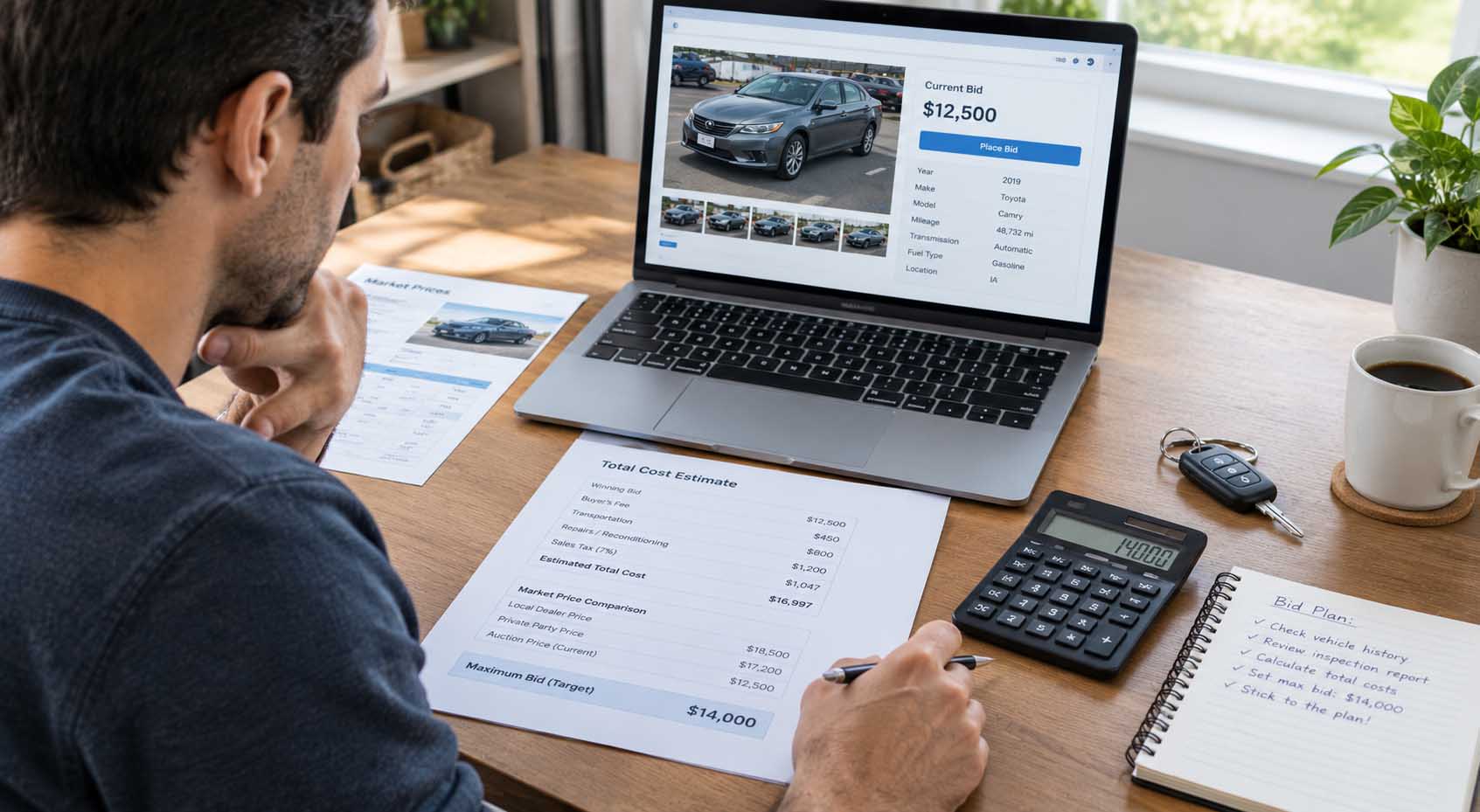
Setting a maximum bid for a used car at auction helps buyers avoid overpaying when competitive bidding increases the purchase price. Instead of choosing an arbitrary amount, buyers should calculate their bidding limit using the vehicle’s market value, expected expenses, condition, and available budget.
A maximum bid is the highest amount someone is willing to offer for a particular vehicle before auction fees and other purchasing costs are added.
For example, a vehicle with an estimated market value of $12,000 may not justify a $12,000 auction bid if the buyer must also pay transaction fees, transportation charges, and repairs.
Therefore, establishing a realistic bidding ceiling before an auction begins is one of the most important steps in responsible vehicle purchasing.
Why Your Maximum Used Car Auction Bid Matters
A realistic maximum bid for a used car at auction depends on evaluating available alternatives. For example, two used sedans may have similar market values but different mileage, maintenance histories, or transportation requirements.
Vehicle auctions create competitive environments where prices can change quickly.
When several participants want the same vehicle, bidding may rise beyond its estimated market value.
Without a predetermined limit, buyers may make emotional decisions based on competition rather than financial value.
A maximum bid provides a clear boundary.
It also encourages buyers to consider the complete acquisition cost instead of focusing only on winning the auction.
The goal is not simply to purchase a vehicle at the lowest possible price. Instead, buyers should aim to obtain a suitable vehicle at a price that makes financial sense.
How to Calculate Your Maximum Bid for a Used Car at Auction
The calculation begins with determining the vehicle’s realistic market value.
Next, subtract the expenses and financial allowances associated with purchasing that specific vehicle.
A practical formula is:
Maximum Bid = Estimated Vehicle Value − Additional Purchase Costs − Repair Allowance − Risk Reserve
This simplified formula assumes additional costs are estimated as fixed amounts.
However, if auction premiums or taxes increase with the winning bid, buyers should calculate those variable expenses separately.
Step 1: Research the Vehicle’s Market Value
Start by comparing vehicles with similar characteristics.
Important factors include:
- Manufacturer and model
- Model year
- Mileage
- Trim level and equipment
- Mechanical condition
- Accident and ownership history
- Geographic market conditions
Vehicle valuation resources and comparable local listings can provide useful reference points.
However, advertised asking prices are not necessarily final selling prices.
Therefore, buyers should examine several comparable vehicles rather than relying on a single listing.
Step 2: Estimate Auction Fees and Taxes
Auction providers may charge buyer premiums, administrative fees, or other transaction expenses.
In addition, sales taxes, title charges, and registration fees may apply.
These costs reduce the amount available for the winning bid.
For example, if a buyer expects $800 in mandatory transaction expenses, that amount should be accounted for before bidding begins.
Always review the specific auction’s published fee schedule because charges differ between providers.
Step 3: Account for Vehicle Repairs
A used vehicle may require maintenance or repairs immediately after purchase.
Potential expenses include tires, brakes, batteries, suspension components, and mechanical diagnostics.
When possible, use inspection findings to estimate realistic repair costs.
A vehicle with documented mechanical concerns may require a substantially lower bid than an otherwise comparable vehicle in good condition.
The Federal Trade Commission’s used-car buying guidance explains why vehicle history information and independent inspections matter when evaluating used vehicles.
Step 4: Include Transportation Expenses
Transportation costs depend on the vehicle’s location, operating condition, and delivery arrangements.
A nearby vehicle that can be legally driven away may involve different expenses from a non-running vehicle requiring professional transportation.
Therefore, buyers should obtain realistic transportation estimates before calculating their final bidding limit.
Example: Calculating a Maximum Bid for a Used Car at Auction
Consider a buyer evaluating a used sedan with an estimated market value of $13,500.
After reviewing its condition and purchasing requirements, the buyer prepares the following estimates:
| Budget Component | Amount |
|---|---|
| Estimated market value | $13,500 |
| Auction fees and taxes | $950 |
| Transportation | $400 |
| Expected repairs | $750 |
| Risk reserve | $500 |
| Calculated maximum bid | $10,900 |
In this hypothetical example, the buyer’s preliminary bidding ceiling is $10,900.
The calculation is:
$13,500 − $950 − $400 − $750 − $500 = $10,900
However, the calculation must be adjusted if taxes or auction fees change according to the final winning bid.
The buyer should also compare the resulting total acquisition cost with personal financial limits.
If the auction price rises beyond the calculated ceiling, withdrawing from the bidding process may be the better decision.
Check Your Maximum Bid Against Your Available Budget
A vehicle’s estimated market value does not determine how much every buyer can afford.
For example, someone with a total purchasing budget of $10,000 cannot reasonably use a $10,900 bidding ceiling when additional costs remain.
Therefore, buyers should compare the value-based calculation with their available funds.
The lower affordable amount should guide the final bidding decision.
Comparing Used Car Auctions Before Setting Your Maximum Bid
A realistic maximum bid depends on evaluating available alternatives.
For example, two used sedans may have similar market values but different mileage, maintenance histories, or transportation requirements.
When buyers explore online vehicle auctions, they should verify the website’s current listings and compare available vehicle details, inspection information, and transaction terms before assigning a bidding limit.
The purpose of comparing listings is to understand the relative value of each vehicle rather than assuming that a lower starting bid represents a better purchase.
A vehicle with a higher initial price may ultimately cost less if it requires fewer repairs or has lower transportation expenses.
Compare Vehicle Condition and Total Acquisition Costs
Before choosing between similar vehicles, review available inspection reports, mileage information, and documented damage.
Next, estimate the total cost of acquiring each vehicle.
For example, a lower-priced car with major mechanical problems may cost more overall than a slightly more expensive vehicle in better condition.
Therefore, buyers should compare estimated ownership expenses rather than focusing exclusively on auction prices.
How Reserve Prices Affect Your Maximum Auction Bid
Some vehicle auctions use reserve prices.
A reserve price is a minimum amount established by the seller that must be met before the vehicle can be sold under the auction’s rules.
In certain auctions, bidding may occur without the reserve being disclosed.
Consequently, the highest bid does not always result in a completed purchase.
Buyers should understand whether the auction uses reserve pricing and whether the seller must approve the final bid.
However, an undisclosed reserve should not encourage buyers to exceed their calculated financial limit.
Avoiding Emotional Bidding Decisions
Competitive bidding can create pressure to increase an offer beyond its planned amount.
This behavior is sometimes called auction fever.
It occurs when the desire to win becomes more important than evaluating the purchase objectively.
Several practical habits can help maintain bidding discipline.
Decide Your Maximum Bid Before the Auction
Calculate the maximum bid while you have time to review vehicle information carefully.
Avoid changing the amount simply because another participant continues bidding.
Instead, use your predetermined ceiling to guide each decision.
Separate Vehicle Value From Personal Preference
A desirable color, trim package, or appearance may influence purchasing interest.
However, personal preference should not replace realistic market comparisons.
For example, an attractive vehicle may still be overpriced when its condition and purchasing expenses are considered.
Be Prepared to Walk Away
Losing an auction does not necessarily represent a missed financial opportunity.
If the price exceeds the vehicle’s estimated value after expenses, stopping protects the buyer’s budget.
Other suitable vehicles may become available through future listings.
Common Mistakes When Calculating Your Maximum Auction Bid
Buyers can underestimate acquisition costs when they overlook important financial details.
Common mistakes include:
- Using advertised retail prices without comparing vehicle condition
- Ignoring buyer premiums and transaction charges
- Underestimating mechanical repair expenses
- Forgetting transportation and registration costs
- Treating the starting bid as an indication of final value
- Increasing the maximum bid during competitive bidding
- Failing to reserve money for unexpected expenses
Avoiding these mistakes makes it easier to establish a financially responsible purchasing strategy.
Why Unexpected Costs Matter
Even careful buyers may encounter expenses that were not obvious before purchasing a vehicle.
For example, a used car may require additional maintenance after transportation or a more detailed mechanical inspection.
Therefore, including a reasonable risk reserve can help protect the purchasing budget.
However, the reserve should reflect the vehicle’s condition and the uncertainty involved rather than an arbitrary amount.
Frequently Asked Questions About Auction Bidding
Should Your Maximum Bid Equal the Vehicle’s Market Value?
Usually not when additional purchasing expenses apply.
Buyers should account for auction fees, transportation, repairs, and other costs before deciding how much to bid.
Can You Change Your Maximum Bid During an Auction?
Some auction platforms allow bidders to increase their offers or proxy-bidding limits.
However, buyers should avoid raising a carefully calculated ceiling without new information that justifies the change.
What Happens If the Reserve Price Exceeds Your Maximum Bid?
The vehicle may remain unsold to you.
Exceeding your budget simply to meet the seller’s reserve may eliminate the financial value of the purchase.
Is the Lowest-Priced Auction Vehicle Always the Best Deal?
No. A lower winning bid can be offset by expensive repairs, transportation, or other ownership costs.
The complete acquisition cost matters more than the bidding price alone.
How Do You Know If Your Auction Bid Is Too High?
Compare the proposed bid with the vehicle’s realistic market value after accounting for fees, repairs, transportation, and financial risk.
If the total estimated acquisition cost exceeds the vehicle’s reasonable value or your available budget, the bid may be too high.
Final Thoughts on Setting Your Maximum Auction Bid
Setting a maximum bid for a used car at auction requires careful research, realistic expense estimates, and disciplined financial planning.
By comparing market values, accounting for transaction charges, and allowing for potential repairs, buyers can establish a bidding limit based on the vehicle’s actual value.
Most importantly, a predetermined ceiling helps prevent emotional decisions during competitive bidding.
A successful auction purchase is not simply about winning. It is about acquiring a suitable vehicle at a total cost that remains reasonable for its condition, market value, and intended use.