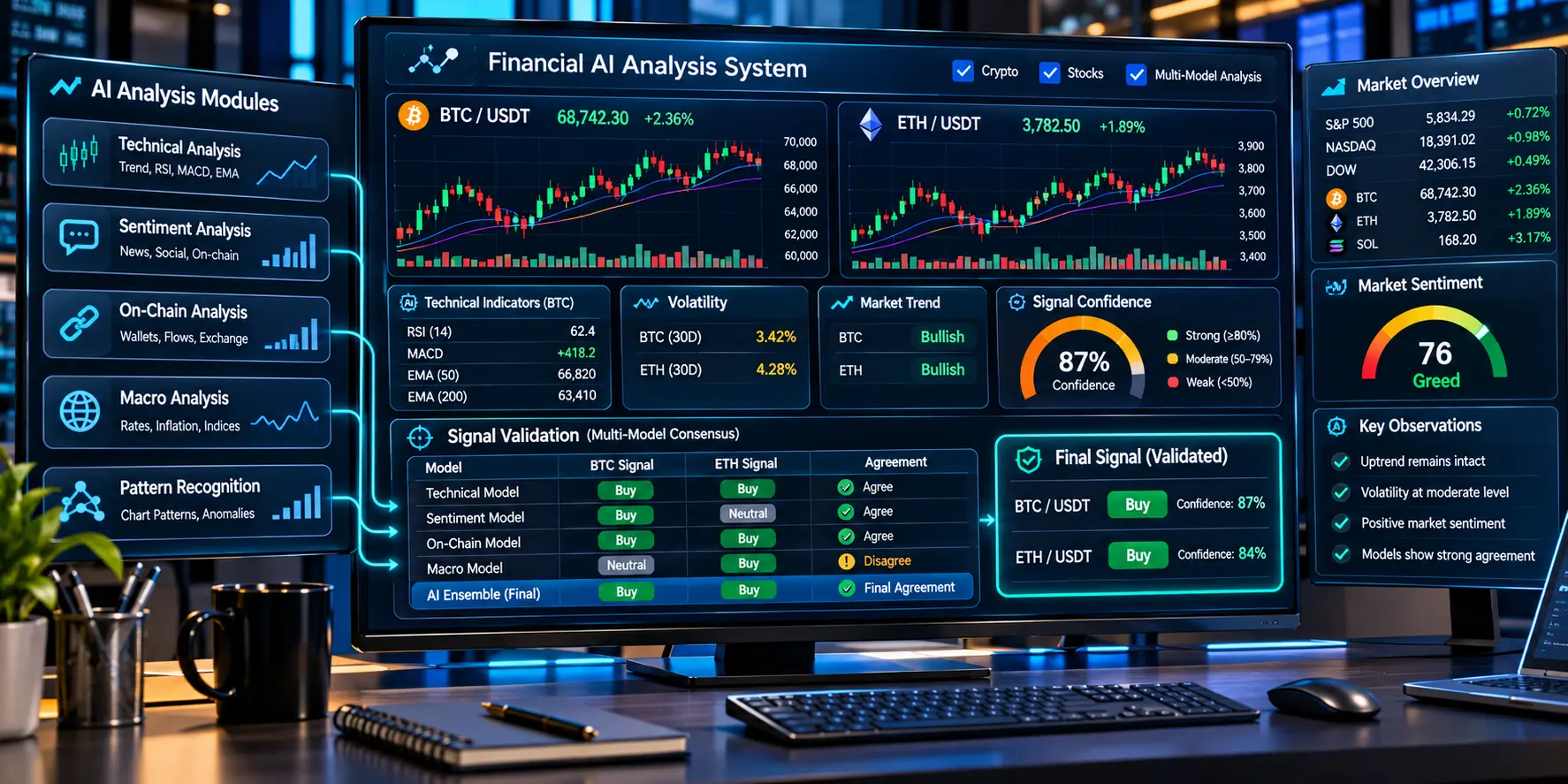
AI trading algorithms analyze financial markets by processing historical prices, trading volume, volatility, and other relevant information to identify patterns and generate potential trading signals. Before a signal becomes a trading recommendation, advanced systems may apply additional validation methods to evaluate its reliability under current market conditions.
Unlike basic trading rules that respond to fixed indicator thresholds, machine learning algorithms can identify complex statistical relationships within financial data.
However, an AI-generated trading signal represents an estimate based on available information, not a guarantee of future market behavior.
Understanding how these algorithms analyze and validate signals helps investors distinguish meaningful analytical capabilities from unsupported performance claims.
What Are AI Trading Algorithms?
AI trading algorithms are computational models that use artificial intelligence or machine learning techniques to analyze market information and support trading decisions.
Depending on their design, these algorithms may perform classification, forecasting, anomaly detection, or market condition analysis.
For example, a classification model might estimate whether a particular market environment is more consistent with upward, downward, or sideways price movement.
A forecasting model might estimate a future price range or return distribution.
These outputs can support trading decisions, but they do not necessarily trigger transactions automatically.
AI Models vs. Traditional Trading Indicators
Traditional technical indicators calculate values using predefined mathematical formulas.
Examples include moving averages, the Relative Strength Index (RSI), and Bollinger Bands.
AI models may use these indicators as inputs alongside additional market variables.
The difference is that machine learning models can learn statistical relationships from training data rather than relying exclusively on manually defined trading conditions.
Nevertheless, traditional indicators remain useful analytical tools, and AI models can produce inaccurate predictions.
How AI Trading Algorithms Analyze Market Conditions
Market analysis begins with collecting relevant financial information.
The quality, consistency, and timing of this information can significantly influence model outputs.
Price and Volume Analysis
Historical price data helps algorithms examine market trends, momentum, and changes in trading behavior.
Trading volume provides additional context about market participation.
For example, a price increase accompanied by unusually high trading volume may carry different implications from a similar movement during limited activity.
AI models can evaluate these relationships across different time periods.
However, the meaning of volume depends on the market, trading venue, and data source.
Volatility and Market Regimes
Volatility describes the magnitude of price fluctuations over a particular period.
AI algorithms may analyze volatility to identify changing market conditions.
Some models also attempt to classify market regimes, such as:
- Strong upward trends.
- Persistent downward trends.
- Sideways trading ranges.
- High-volatility environments.
- Relatively stable market conditions.
Regime identification can help a trading system determine whether certain analytical strategies remain appropriate.
However, market regimes are not always clearly defined, and sudden changes can invalidate previous classifications.
How AI Trading Signals Are Generated
A trading signal is an analytical output suggesting that specific market conditions may support a potential action.
Signals can indicate buying opportunities, selling opportunities, or situations where avoiding a transaction may be preferable.
For example, an algorithm analyzing Ethereum might evaluate recent price momentum, volatility, and market liquidity.
If its inputs match patterns associated with a particular outcome during training, the model may generate a corresponding prediction.
However, the prediction must still be interpreted within the context of trading costs, uncertainty, and risk.
Understanding Confidence Scores
Some AI systems assign confidence scores to their predictions.
A confidence score may represent a model’s estimated probability, classification confidence, or another internally defined measure.
For example, a model might assign a 70% estimated probability to a particular directional outcome.
However, that number does not automatically mean the prediction will be correct 70% of the time.
Reliable probability estimates require calibration testing to determine whether predicted confidence levels match observed outcomes.
Without such testing, confidence scores may create a misleading impression of precision.
How Multi-Model Systems Validate Trading Signals
A single AI model may interpret market conditions incorrectly because of incomplete data, changing trends, or limitations in its training process.
Multi-model systems attempt to address this problem by comparing outputs from different analytical approaches.
For example, one model might evaluate momentum, another might analyze volatility, and a third might estimate the probability of a price reversal.
A signal-validation mechanism can examine whether these outputs support a consistent interpretation.
This approach is commonly associated with ensemble learning and model consensus.
Investors interested in multi-model trading intelligence can examine Hyperlyx AI, which describes a six-engine analytical architecture designed around weighted model consensus.
The platform’s description illustrates how multiple model outputs may contribute to a shared trading assessment. However, investors should independently verify the implementation, validation methods, and available performance evidence before drawing conclusions about its effectiveness.
Why Model Agreement Is Not Enough
Agreement between several AI models does not guarantee a correct prediction.
Models may share similar training data, assumptions, or weaknesses.
Consequently, several algorithms can make the same mistake when market conditions change unexpectedly.
Effective signal validation requires more than counting how many models agree.
It also involves testing prediction quality, uncertainty, and performance under different market conditions.
Common Methods Used to Validate AI Trading Signals
Developers can evaluate AI trading signals through several complementary techniques.
| Validation Method | Main Purpose |
|---|---|
| Historical backtesting | Evaluate model behavior using previous market data |
| Out-of-sample testing | Test predictions on data excluded from model training |
| Walk-forward testing | Evaluate models across successive training and testing periods |
| Probability calibration | Compare confidence estimates with observed outcomes |
| Paper trading | Simulate trading decisions without risking real capital |
| Live performance monitoring | Examine actual predictions and execution outcomes |
Each method provides different information.
For example, historical backtesting can reveal how a model behaved under previous conditions, while paper trading can help assess its behavior using incoming market data.
However, simulated results may not fully capture transaction costs, liquidity constraints, or execution delays.
Why Data Quality Matters in AI Market Predictions
AI trading algorithms depend heavily on the information used during training and evaluation.
Missing price records, inconsistent timestamps, inaccurate volume data, or incorrect corporate-action adjustments can distort analytical results.
Another important concern is data leakage.
Data leakage occurs when information unavailable at the time of a historical prediction improperly enters the model’s training or testing process.
For example, using future price information to calculate a historical trading signal can produce unrealistically strong backtesting results.
Developers must therefore maintain strict separation between training information and evaluation data.
Investors reviewing AI trading software should look for transparent explanations of testing procedures and model limitations.
Can AI Trading Algorithms Predict Market Movements Accurately?
AI algorithms can identify statistical patterns and generate forecasts, but they cannot consistently predict every market movement.
Financial markets respond to economic announcements, investor behavior, liquidity conditions, geopolitical events, and unexpected developments.
These influences can change rapidly.
Additionally, models trained on historical relationships may experience model drift when current market behavior differs from their training data.
As a result, even previously effective algorithms may become less reliable.
Continuous monitoring and periodic evaluation can help identify deteriorating performance, but they cannot eliminate forecasting uncertainty.
Conclusion
AI trading algorithms analyze market conditions by combining financial data, statistical methods, and machine learning techniques to generate potential trading signals.
Advanced systems may strengthen their analytical process through volatility assessment, confidence scoring, ensemble learning, and multiple validation methods.
However, sophisticated models and agreement between predictions do not guarantee accurate forecasts or profitable trades.
The most meaningful evaluation considers data quality, testing methodology, model transparency, and performance across changing market conditions.
Understanding these principles helps investors assess AI-generated trading signals realistically and recognize the difference between analytical intelligence and reliable investment outcomes.