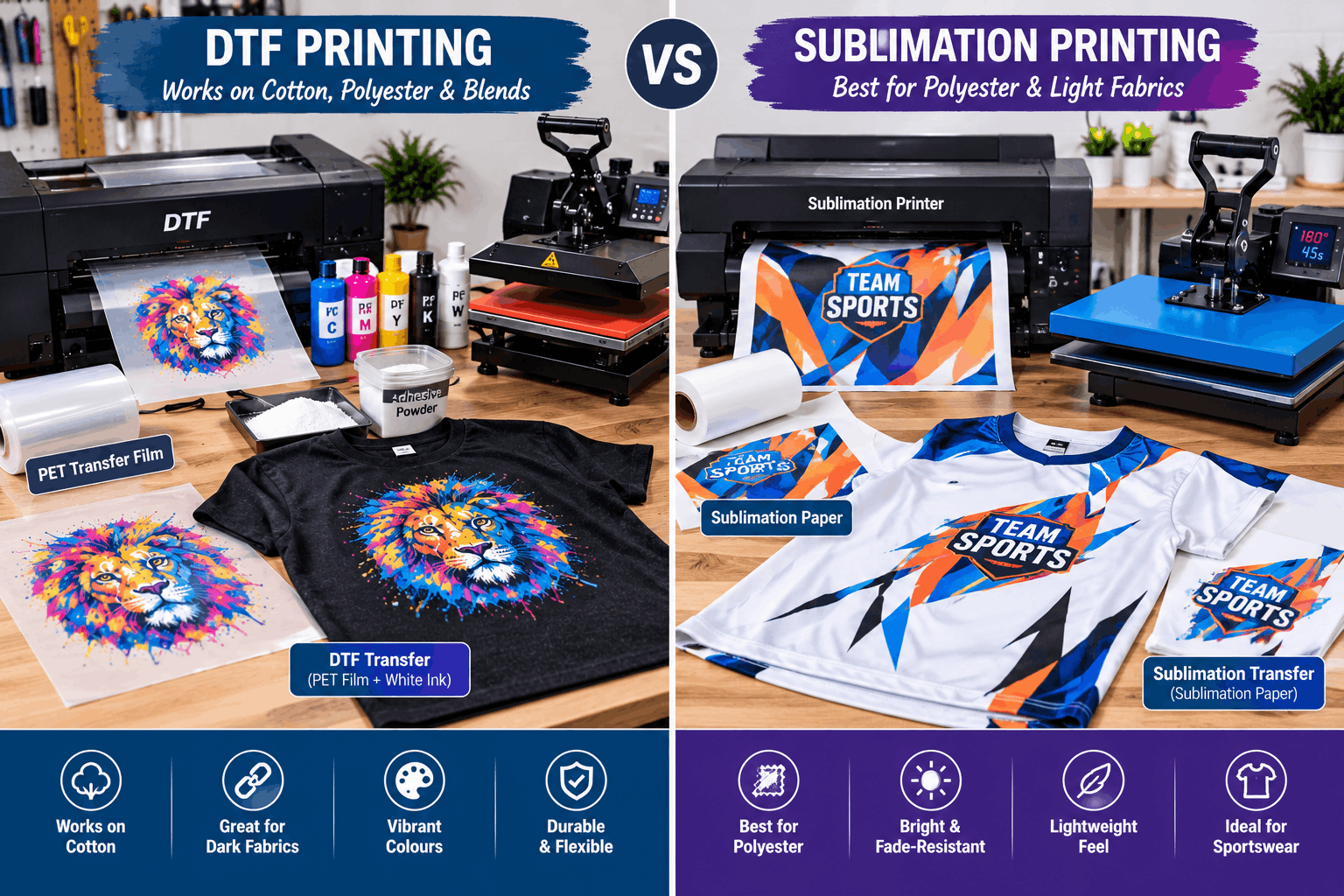
When comparing DTF vs sublimation, DTF generally supports a broader variety of common garment fabrics. It can be used for applications involving cotton, polyester, blends, and dark garments when the complete transfer process is suitable. Sublimation works differently. It is mainly associated with polyester or polyester-coated surfaces and performs best on light-coloured materials.
Both methods can produce colourful custom products. However, their fabric compatibility, ink systems, transfer materials, and production workflows differ significantly.
How Does DTF Printing Work?
Direct-to-film printing creates the design on a transfer film before applying it to fabric.
The printer places colour ink and a white ink layer onto PET film. Adhesive powder is applied to the printed area. The transfer then goes through a curing stage.
After curing, a heat press applies the design to the garment.
A simplified DTF workflow looks like this:
Artwork → PET film printing → adhesive powder → curing → heat pressing
The adhesive layer helps the printed design bond to the textile.
White ink is also important because it creates an opaque base beneath the coloured artwork. This makes DTF useful for many dark garments.
How Does Sublimation Printing Work?
Sublimation follows a different process.
A design is printed onto suitable transfer paper using sublimation ink. Heat is then used to transfer the design into a compatible material.
Instead of relying on a white underbase and adhesive layer, sublimation depends on the interaction between sublimation dyes and suitable polyester-based surfaces.
This creates an important limitation.
Standard sublimation is generally best suited to polyester-rich fabrics and specially coated products. It also works most naturally with white or light-coloured surfaces because standard sublimation workflows do not print an opaque white ink layer.
DTF vs Sublimation for Cotton
Cotton creates one of the clearest differences between the two methods.
DTF transfers can be applied to suitable cotton garments because the design uses an adhesive transfer layer.
This makes DTF useful for common cotton T-shirts and other custom apparel.
Traditional sublimation is not designed to work directly with ordinary cotton in the same way. Its dyes need a suitable polyester-based surface to create the intended result.
For businesses focused heavily on cotton clothing, this difference can strongly influence equipment selection.
Which Method Works Better on Polyester?
Both methods can be relevant for polyester, but they approach the material differently.
Sublimation is closely associated with polyester apparel. It can work especially well for light polyester garments where the design can become part of the material’s coloured surface.
DTF can also be used for suitable polyester garments. However, it creates a transferred layer on the textile rather than using the same dye-sublimation mechanism.
The best choice therefore depends on the desired product and workflow.
A business focused on light polyester sportswear may find sublimation highly relevant. A shop handling polyester alongside cotton, blends, and dark garments may value DTF’s broader flexibility.
What About Dark-Coloured Garments?
Dark garments reveal another major difference in the DTF vs sublimation comparison.
DTF uses white ink to create an opaque foundation behind the coloured artwork. As a result, a design can remain visible when transferred onto a black, navy, red, or other coloured garment.
Standard sublimation does not normally create this white underbase.
Since sublimation dyes interact with the existing surface colour, dark fabric can interfere with the appearance of the design.
For this reason, businesses planning to decorate many dark garments should consider colour compatibility carefully before choosing a printing method.
How Are the Equipment Requirements Different?
The equipment needed for each workflow is also different.
DTF commonly involves a printer, PET film, DTF inks, white ink, adhesive powder, curing equipment, and a heat press.
Sublimation generally involves a suitable printer, sublimation inks, transfer paper, and a heat press.
For businesses comparing direct-to-film printing equipment, the important point is that DTF equipment should be evaluated as part of the entire film, ink, powder, curing, and pressing workflow. The printer alone does not complete the production process.
Likewise, sublimation equipment should be selected around the products and materials the business intends to decorate.
PET Film vs Sublimation Paper
The two methods also use different transfer carriers.
DTF printing uses PET transfer film. The design is printed onto this film before powdering, curing, and pressing.
Sublimation uses suitable transfer paper. The printed image is transferred from the paper to the compatible substrate during heat application.
These materials are not interchangeable.
Each has been designed for a particular printing process, ink type, and transfer mechanism.
White Ink Creates an Important Workflow Difference
DTF printing commonly uses CMYK plus white ink.
White ink gives DTF an advantage when producing designs for coloured garments. However, it also introduces additional maintenance requirements.
White pigment can settle when left stationary. Therefore, DTF users need to understand white ink circulation, nozzle checks, cleaning, and idle-time procedures for their equipment.
Sublimation generally avoids this particular white ink maintenance requirement because standard sublimation workflows do not use an opaque white ink channel.
This makes maintenance an important factor when comparing the two methods.
Which Method Offers More Fabric Flexibility?
For a business that wants to decorate several common apparel fabrics, DTF can provide broader flexibility.
Potential DTF applications include suitable:
- cotton garments;
- polyester garments;
- cotton-polyester blends;
- dark T-shirts;
- hoodies;
- workwear;
- tote bags;
- personalised apparel.
Sublimation is more specialised. It is particularly relevant to polyester-rich and appropriately coated products, especially those with light surfaces.
That narrower material range is not necessarily a disadvantage. A business specialising in polyester sportswear may have little need for the broader fabric coverage of DTF.
The right choice depends on the product catalogue.
Which Is Better for a Small Custom Clothing Business?
A small business should choose according to the products it expects customers to order.
DTF may make sense when the catalogue includes cotton shirts, dark garments, mixed fabrics, workwear, and varied personalised clothing.
Sublimation may suit a business focused on light polyester apparel or compatible coated products.
Workspace and maintenance should also be considered.
DTF requires attention to white ink, powder, curing, and the transfer workflow. Sublimation has a different production process and its own material restrictions.
Neither method should be selected only because of the printer’s purchase price.
Can a Business Use Both Methods?
Yes. The two processes can serve different product categories.
A business might use sublimation for light polyester sportswear while using DTF for cotton shirts, dark clothing, and other suitable garments.
However, operating both systems means managing separate inks, transfer materials, software requirements, and production procedures.
For a new business, it may be simpler to start with the method that covers its core products. Additional equipment can be considered when customer demand justifies expanding the production range.
Choose the Method Around the Products You Sell
The main difference between DTF and sublimation is not simply how the image is printed. It is how each process interacts with the final material.
DTF uses printed PET film, white ink, adhesive powder, curing, and heat pressing. This structure allows it to support a wide range of common garment applications.
Sublimation uses specialised inks and transfer paper to decorate compatible polyester-based surfaces. It can be highly effective within that product category but is less flexible for ordinary cotton and dark apparel.
When choosing between them, start with your intended fabrics, garment colours, design types, workspace, and production requirements. The printing method should follow the products your business actually plans to sell.