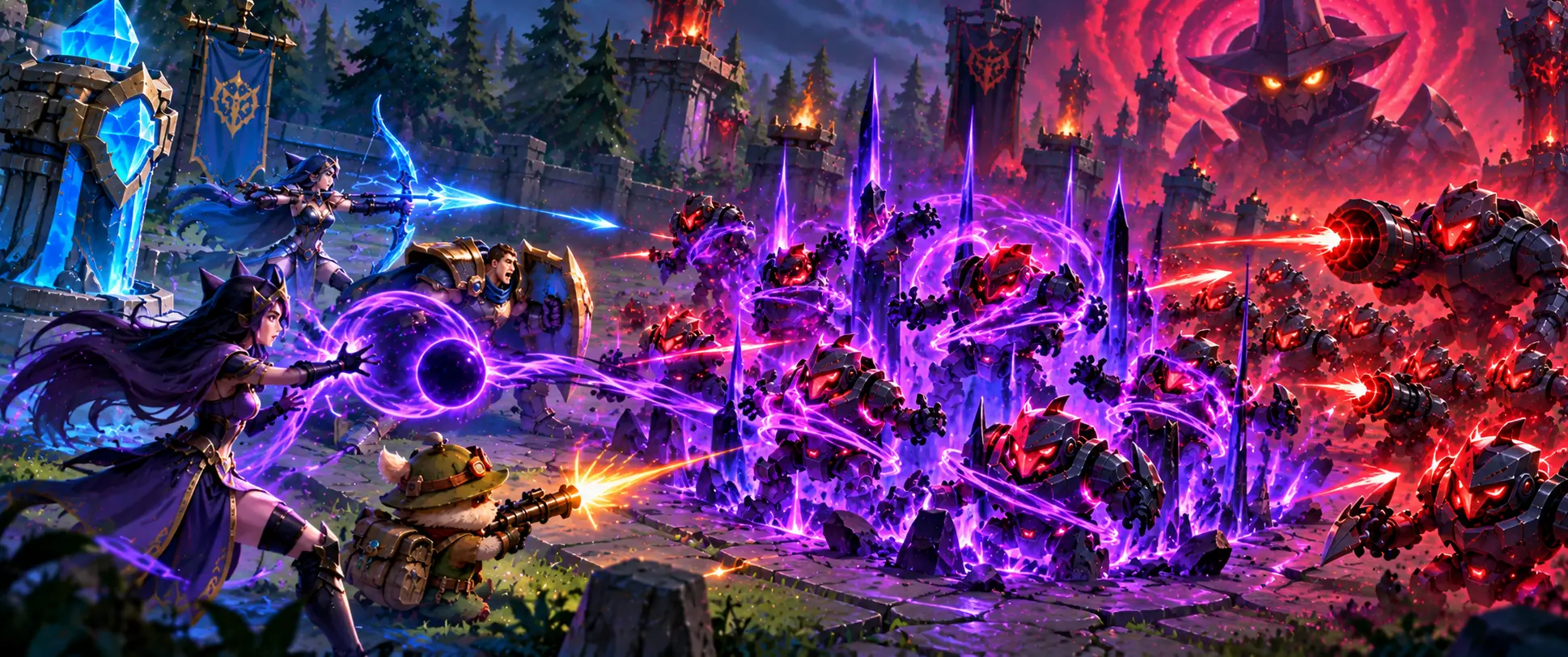
Effective crowd control in Doom Bots helps a team manage dangerous enemies instead of relying entirely on raw damage. Roots, stuns, slows, knockups, zoning abilities, shields, and other utility tools can create safer opportunities for teammates to attack, reposition, clear waves, or escape pressure.
This makes crowd control and utility important parts of PvE team strength. A champion does not need to produce the highest damage numbers to make a major contribution when its abilities consistently make difficult situations easier for the entire group.
What Does Crowd Control Do in Doom Bots?
Crowd control, commonly shortened to CC, refers to effects that restrict or influence how enemies can move or act.
Common forms include:
- Stuns
- Roots
- Slows
- Knockups
- Displacement effects
- Other movement restrictions
These effects serve a simple purpose: they give the team more control over the encounter.
If several enemies are advancing toward a vulnerable ranged champion, slowing or immobilizing them creates additional time to respond. That extra time can allow teammates to deal damage before those enemies reach dangerous positions.
In this way, crowd control indirectly supports both offense and defense.
Why Crowd Control in Doom Bots Matters
Doom Bots can create situations where several threats demand attention at the same time.
Damage helps remove those threats, but teams may not always eliminate every enemy immediately. Crowd control provides another solution by temporarily limiting what dangerous targets can do.
A controlled enemy is easier to position around and often easier for teammates to attack.
This can be particularly useful when enemies become grouped together. A well-placed control ability can delay multiple targets while an AoE-focused teammate damages the entire group.
Crowd control therefore works best when it creates opportunities for the rest of the composition rather than functioning as an isolated mechanic.
Crowd Control Makes AoE Damage More Effective
Area-of-effect damage becomes easier to apply when enemies remain inside the same area.
This creates a natural relationship between AoE champions and control-focused picks.
Suppose a mage has an ability capable of damaging several targets. If those enemies are moving in different directions, the player may hit only part of the group. A teammate who slows or roots those enemies can make the damage ability much easier to place effectively.
The result is more efficient wave management without requiring either champion to perform every job.
One champion controls the group. Another takes advantage of that control.
This kind of role interaction is one reason team composition matters so much in Doom Bots.
Slows Create Time and Space
Slows may appear less dramatic than hard crowd-control effects, but they can provide consistent practical value.
Reducing enemy movement speed gives ranged champions more time to attack before threats reach them. It can also help teammates reposition without immediately losing control of the area.
Slows are especially useful when they can affect multiple enemies.
An AoE slow can change how an entire group approaches the team, creating a temporary zone that becomes difficult for enemies to cross quickly.
That extra space can help damage dealers maintain safer positions and reduce pressure on frontline champions.
The strength of a slow is therefore not only the effect itself. Its value comes from what teammates can do with the additional time it creates.
Roots and Stuns Can Stop Immediate Threats
Harder forms of crowd control can be useful when the team needs a more direct answer.
A root can prevent movement, while a stun can temporarily stop an enemy from acting. These effects can interrupt dangerous pressure and create a short window in which teammates can respond.
Timing matters.
Using an important control ability on a low-priority enemy may leave it unavailable when a more dangerous threat appears moments later.
Players should therefore consider which enemies actually need to be controlled.
Good CC usage is not about casting every ability as soon as it becomes available. It is about applying control where it creates the greatest advantage.
Utility Extends Beyond Crowd Control
Utility includes abilities that help the team even when they do not directly increase personal damage.
Examples can include:
- Shields
- Healing
- Movement assistance
- Zoning
- Defensive buffs
- Protection for vulnerable allies
- Vision or information tools where relevant
- Abilities that create safer positioning
These tools can change how effectively teammates perform their own roles.
A shield may allow a ranged damage dealer to remain active longer. Healing can help a frontline champion continue occupying dangerous space. Movement assistance may help a teammate escape or reposition before a threat becomes overwhelming.
Utility is valuable because its benefit can spread across the composition.
Control Can Protect Fragile Damage Dealers
High-damage champions are not always durable.
A fragile ranged champion may contribute excellent sustained DPS or wave clear but become vulnerable when enemies reach the backline.
Crowd control can compensate for this weakness.
Instead of requiring the damage dealer to survive direct pressure alone, another champion can slow, root, or otherwise restrict approaching threats.
This creates a defensive layer between the enemy and the carry.
When considering how control-focused champions fit alongside damage, frontline, and wave-clear picks, this Doom Bots guide provides broader context for comparing champion strengths within the mode.
The important point is that champion value depends partly on how well a pick supports the rest of the team.
Zoning Can Control Space Without Directly Stopping Enemies
Not every useful control tool needs to apply a stun or root.
Zoning abilities influence where enemies can safely move. A threatening area on the battlefield may force enemies into less favorable paths or make a particular approach easier for the team to defend.
This can be especially useful when players need to protect a position.
A control mage may place abilities in areas enemies are likely to cross, while teammates position around those zones. Even if every target is not directly immobilized, the ability can still influence the encounter.
Zoning therefore represents another form of battlefield control.
Its value comes from shaping movement rather than simply dealing damage.
Too Much Control Can Create a Damage Problem
Crowd control is useful, but a team still needs enough damage to remove enemies.
A composition filled with defensive utility but lacking reliable damage may delay threats without actually resolving them.
This creates an important balance.
Control should create opportunities for damage. Damage should capitalize on the time and positioning advantages that control provides.
A strong composition might combine a frontline champion, an AoE damage dealer, sustained DPS, and one or more champions offering useful control or support.
Several of those responsibilities can overlap.
For example, a mage may provide both AoE damage and roots, while a support-oriented champion may combine shielding with slows.
The goal is not to assign one champion exclusively to each function. It is to make sure the team collectively covers them.
Is Crowd Control More Important Than Damage?
Neither is universally more important because they solve different problems.
Damage removes threats. Crowd control manages threats while they are still alive.
A team needs enough offensive pressure to progress, but control can make that damage much easier and safer to apply.
The relationship becomes especially clear during difficult situations.
If enemies are already under control, additional damage may help finish them quickly. If several enemies are reaching vulnerable teammates at once, another damage ability may not solve the immediate positioning problem as effectively as a root, stun, or slow.
The best answer depends on what the composition currently lacks.
Utility Becomes Stronger Through Coordination
Many utility abilities gain value when teammates recognize and use the opportunity they create.
A root is more useful when allies immediately attack the controlled target. A slow becomes more valuable when ranged champions maintain distance instead of moving closer unnecessarily. A shield is most effective when used on a teammate who is actively contributing under pressure.
This means coordination turns utility into practical team strength.
Players do not need complicated communication for this to work. Simply recognizing what teammates are trying to accomplish can improve the effectiveness of control abilities.
When one champion creates an opening and another responds correctly, both become more useful.
Crowd Control Helps a Team Stay Organized
Crowd control in Doom Bots matters because it reduces the number of threats a team must handle simultaneously. Slows create space, roots and stuns can stop immediate pressure, while zoning influences how enemies approach important areas.
Utility adds another layer by protecting teammates, improving survivability, and supporting better positioning.
These tools do not replace damage. Instead, they create safer and more reliable opportunities for damage dealers, wave-clear champions, and frontline fighters to perform their roles.
A balanced team treats crowd control and utility as force multipliers: abilities that make the strengths of other champions easier to use when PvE pressure becomes difficult to manage.