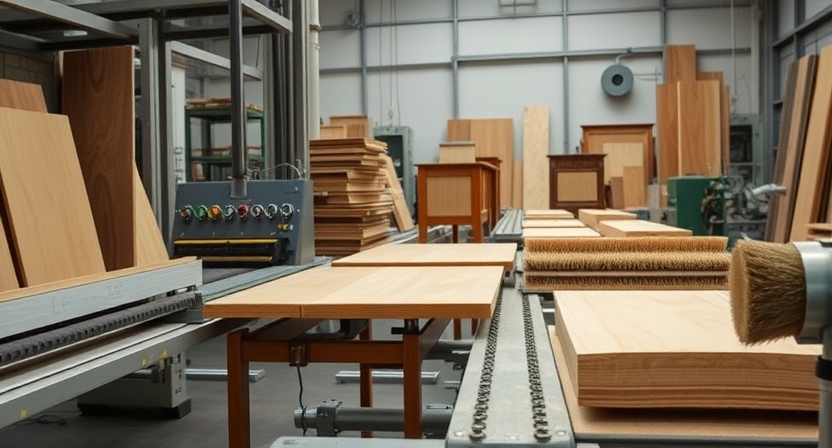
Choosing the right sanding machine for furniture production starts with the workpiece and the required finish. Wide belt sanders are commonly suited to flat panels, calibration, and consistent surface sanding, while brush sanders can be useful for profiles, contours, edges, and more complex surfaces. The correct choice also depends on material, working width, feed speed, abrasive setup, and whether sanding happens before or between finishing stages.
Sanding should not be treated as an isolated operation. It prepares furniture components for later processes such as staining, painting, coating, or final assembly, so the machine needs to fit both the material and the wider production workflow.
What Does a Furniture Sanding Machine Do?
Industrial sanding equipment removes or smooths material from a wood or panel surface using abrasives.
However, not every sanding task has the same objective. A manufacturer may need to level a panel, remove machining marks, prepare a surface for coating, smooth a solid-wood component, or sand between finishing stages.
These different purposes influence machine selection.
A factory processing large flat panels, for example, has different requirements from a manufacturer producing profiled cabinet doors, moulded components, or shaped furniture parts.
Wide Belt Sanders for Flat Furniture Components
A wide belt sander uses abrasive belts across a defined working width to process panels or other relatively flat workpieces.
It is commonly associated with tasks such as:
- Panel calibration
- Surface leveling
- Removing machining marks
- Preparing wood for finishing
- Sanding MDF and other panel materials
- Processing solid-wood panels
Calibration is particularly important when components need a consistent thickness or surface condition before moving to another production stage.
A wide belt machine can provide a repeatable sanding process for panels moving through a production line. However, the configuration should match the actual workpiece dimensions, material, and required surface quality.
When Is a Brush Sander More Suitable?
Brush sanding serves a different purpose from conventional wide belt sanding.
Flexible abrasive brushes can interact with surfaces that are difficult to process uniformly with a flat sanding belt. Depending on the machine and abrasive configuration, this can make brush sanding useful for profiles, edges, grooves, contours, or textured components.
For example, a routed cabinet door may contain recessed areas and shaped details. A standard flat sanding process may address the main surface but may not interact with every contour in the same way.
Brush sanding can therefore complement other sanding methods rather than simply replace them.
The correct choice depends on component geometry and the finish required.
How to Choose a Sanding Machine for Furniture Production
The most useful way to select a sanding machine is to define the sanding task before comparing equipment specifications.
Identify the Material
Solid wood, MDF, plywood, veneered panels, and coated surfaces can respond differently to sanding.
The abrasive selection and machine configuration should suit the material being processed. A process designed for heavy calibration of solid wood is not automatically appropriate for a delicate surface or a finishing-stage operation.
Define the Desired Result
Ask what the sanding stage needs to accomplish.
Is the goal to establish consistent thickness? Remove cutter marks? Prepare a panel for painting? Smooth a profiled surface? Sand between coating stages?
Clear answers help determine whether the production line needs wide belt sanding, brush sanding, another specialized process, or a combination.
Measure the Workpieces
Machine working width should accommodate the components the factory actually produces.
Buying equipment without considering maximum panel dimensions can restrict production later. At the same time, selecting capacity far beyond normal requirements may add unnecessary complexity.
Why Working Width and Feed Speed Matter
Working width defines the size of workpiece a sanding machine can accommodate, while feed speed influences how material moves through the sanding process.
Neither specification should be considered alone.
A factory needs to evaluate how the machine interacts with its upstream and downstream processes. If components arrive from CNC machining faster than sanding can handle them, work can accumulate before the finishing stage.
Likewise, increasing feed speed is useful only when the required surface condition can still be achieved.
When comparing wood sanding equipment, manufacturers should therefore consider working dimensions, feed system, abrasive configuration, intended material, and required finish as parts of the same production decision.
Calibration Sanding and Finish Sanding Are Different
Calibration focuses on establishing a more consistent thickness or level surface. It may involve removing more material to correct variations across the workpiece.
Finish sanding generally focuses more on surface condition. The objective may be to remove previous sanding marks, refine the surface, or prepare it for a subsequent finishing operation.
A production process may use multiple abrasive stages to move from more aggressive material removal toward a finer surface.
Therefore, manufacturers should avoid choosing a machine solely because it is described broadly as a sander. Its sanding units and abrasive setup need to correspond to the actual stage of production.
What About Lacquer and Coating Preparation?
Furniture finishing can introduce additional sanding requirements.
Painted or coated components may need carefully controlled surface preparation before another finishing layer is applied. The objective is different from heavy stock removal on raw timber.
Manufacturers should consider the coating system, surface characteristics, component shape, and finishing process when selecting machinery for this stage.
Abrasive choice also matters. An unsuitable abrasive or overly aggressive process can affect the surface rather than prepare it as intended.
For this reason, finishing-stage sanding should be planned together with the coating process.
Dust Extraction Is Part of the Sanding System
Sanding generates fine dust and removed material, making dust extraction an important part of the overall equipment setup.
A sanding machine should operate within an appropriate dust-management system suited to the materials and processes involved.
Effective extraction also helps keep machinery and the surrounding production area cleaner. In addition, accumulated dust can interfere with workpiece surfaces and ongoing operations.
Factories should therefore account for extraction requirements when planning machine placement and production layout rather than treating dust management as an afterthought.
Should a Factory Use More Than One Type of Sander?
In many production environments, different components require different sanding methods.
A factory might use wide belt sanding for flat panels while using brush sanding for profiled doors or shaped parts. Manual or specialized sanding may still be required for areas that automated equipment cannot process appropriately.
The goal is not necessarily to make one machine perform every sanding task.
Instead, manufacturers should map component types and determine which surfaces need calibration, general smoothing, profile sanding, or finishing preparation.
This makes it easier to build a sanding process around actual production requirements.
Selecting Sanding Equipment Around the Finished Product
The right sanding machine depends ultimately on what the factory needs the finished surface to become.
Flat panels requiring calibration may point toward wide belt sanding. Shaped or profiled components may require brush-based processing. Furniture with demanding coating stages may need a sanding sequence designed specifically around surface preparation.
Material, geometry, working width, feed speed, abrasives, dust extraction, and the next manufacturing stage should all be considered together. By starting with the workpiece and desired surface rather than choosing machinery by category alone, furniture manufacturers can create a sanding process that fits naturally into the complete production workflow.